If your hair is thinning and you have started looking into your options, you have probably found that every website recommends whatever that website sells. Extension companies recommend extensions. Wig shops recommend wigs. It makes an already difficult decision harder.
So here is the short version. The right option depends less on how much hair you have lost and more on where you have lost it, how much tension your hair can safely carry, and whether you need scalp coverage or just more density. Extensions add length and fullness through the lengths but do nothing for a visible part. Toppers cover the crown but need healthy hair around the edges to blend. Wigs cover everything but replace your own hair rather than working with it. Strand-by-strand integration adds density without a base or adhesive, but requires some existing hair to attach to.
Below is an honest comparison of all six approaches, including the trade-offs each one carries.
What are your actual options?
Most women researching this run into six distinct categories, though the marketing language often blurs them together.
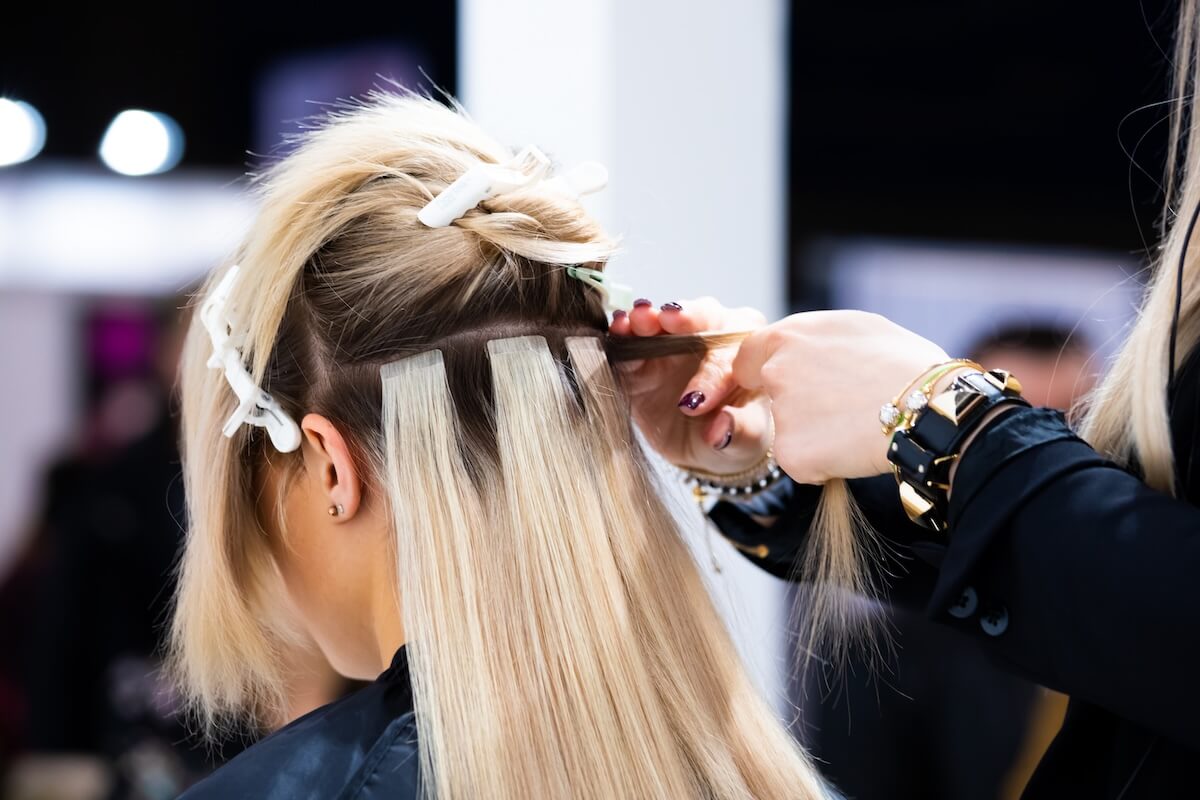
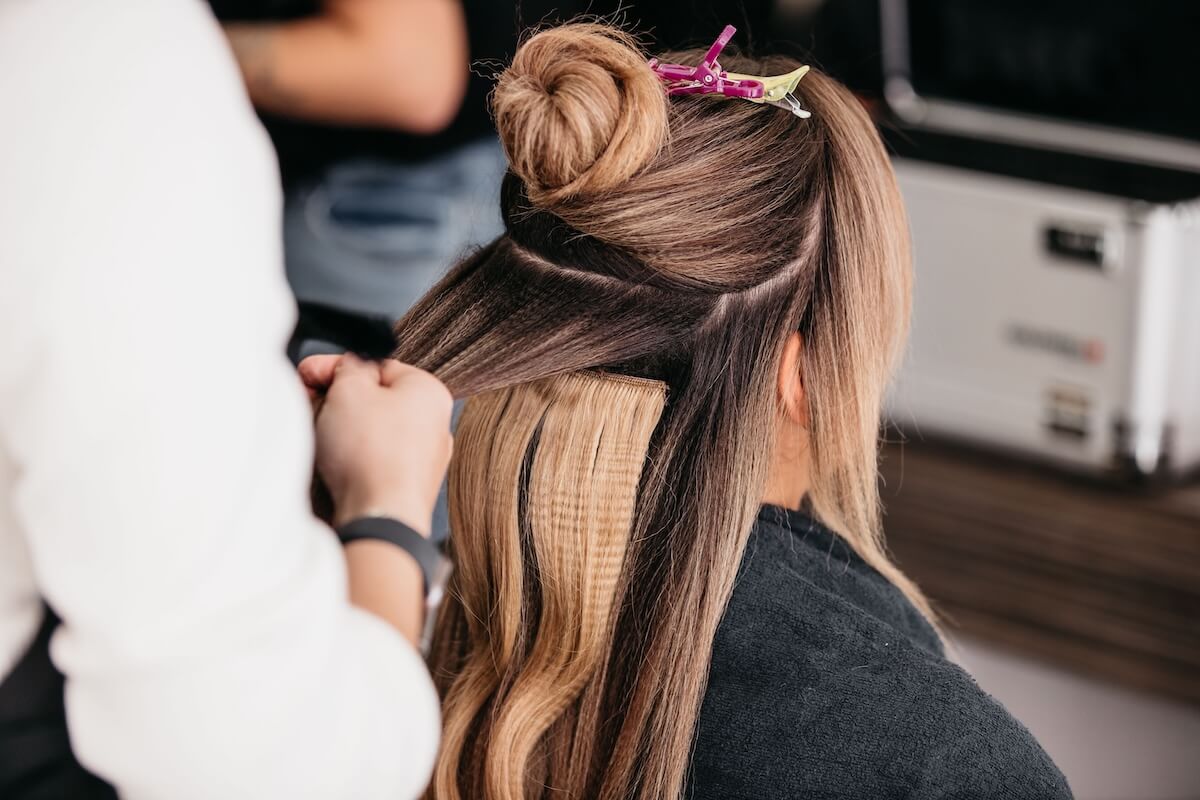
- Clip-in and tape-in extensions. Wefts of hair attached with clips or adhesive tabs across a wide section of your own hair. Clip-ins come out daily; tape-ins stay in for weeks.
- Bonded and micro-ring extensions. Individual small bundles attached to a few strands each, using keratin bonds or small metal rings.
- Hair toppers. A hairpiece with its own base that sits over the crown and part, usually held by small clips at the perimeter.
- Wigs. Full-coverage hairpieces that replace all visible hair.
- Mesh integration. A fine net fitted over the thinning area, with your own hair pulled through the holes and additional hair tied into the netting.
- Strand-by-strand integration. Added hair attached directly to small groups of your own strands, with no base, netting, glue, or clips.
Comparison at a glance
| Option | What it actually adds | Covers a visible part or scalp? | Tension on your own hair | Removable daily? | Typical upkeep |
|---|---|---|---|---|---|
| Clip-in extensions | Length and fullness through the mid-lengths and ends | No | Low if removed daily; clips can irritate a sensitive scalp | Yes | None beyond washing the hair itself |
| Tape-in extensions | Length and fullness; weight spread across a wide section | No | Low to moderate | No | Move-up every 6–8 weeks |
| Bonded / micro-ring extensions | Length and fullness, placed more precisely | No | Higher — weight concentrated on very few strands | No | Move-up every 6–10 weeks |
| Hair topper | Coverage and lift at the crown and part | Yes | Concentrated at the clip points along the perimeter | Yes | Wash and style the piece separately |
| Wig | Complete coverage; a full change of length, colour, or texture | Yes — entirely | Minimal on the hair itself | Yes | Wash and style the piece; heavier and warmer to wear |
| Mesh integration | Density over a mapped thinning area | Partially — the netting sits above the scalp | Distributed, but the net anchors to your hair | No | Refit every 5–8 weeks |
| Strand-by-strand integration | Density and length blended in at the root, plus part and crown fullness | Yes | Distributed across many small groups of strands | No | Periodic maintenance as your own hair grows |
Which option fits which kind of hair loss?
This is where most of the confusion happens, because the same product can be right for one woman and wrong for another with the same amount of loss. What matters is the pattern. If you are not yet sure what is driving your hair loss, it is worth understanding the cause first — the answer often changes which options are realistic.
Diffuse thinning across the whole scalp
This is the most common pattern in women, and it is typical of hormonal thinning during perimenopause, menopause, thyroid conditions, or PCOS. The hair gets finer everywhere rather than disappearing in patches.
Extensions are usually the wrong tool here. They add weight through the lengths while the actual problem — reduced density at the root and a widening part — goes untouched. Many women try extensions first, spend a significant amount, and still feel their hair looks thin where it bothers them most. Toppers help the crown but can leave an obvious density mismatch where the piece ends. Integration methods tend to suit this pattern best because they add density where the hair has thinned rather than only below it.
Thinning concentrated at the part and crown
If your sides and back are still reasonably dense, you have the most options. A topper uses that surrounding hair as a natural frame and can look convincing. Integration also works well. A wig is usually more coverage than you need, and often warmer and heavier than the situation warrants.
Patchy or localised loss
Patchy loss from alopecia or from trichotillomania needs an approach that can be mapped to specific areas. Off-the-shelf toppers are built for a standard crown shape and frequently do not sit where the loss actually is. Custom solutions matter more here than product category.
Total or near-total loss
After chemotherapy, or with advanced alopecia, there may not be enough remaining hair for anything to attach to. A wig or a medical-grade prosthesis is the honest answer in that situation, and any provider who tells you otherwise is selling rather than advising. Integration methods require some existing hair — though often less than women assume.
Breakage and length that will not hold
If your hair grows but snaps off before it gains length — common after years of colour, heat, or chemical processing, and also during postpartum regrowth — the problem is fragility rather than density. This is the situation where added weight and tension are most likely to make things worse, and where method selection matters more than in any other scenario.
The five questions that actually decide it
Product comparisons tend to focus on price and appearance. In practice, these are the factors that determine whether a woman is still happy with her choice a year later.
- How much tension can your hair carry? Every attached method places some load on your own strands. The safest ones spread that load across a wide section; the riskiest concentrate it on a few strands. If your hair is already fine or fragile, this is the single most important question.
- Do you need scalp coverage, or just more hair? Be honest about what bothers you when you look in the mirror. If the answer is “I can see my scalp,” extensions will not solve it, no matter how much hair you add.
- Can you live with the maintenance rhythm? Some options need a salon visit every six weeks indefinitely. Others need daily removal and restyling. Neither is worse — but one of them will fit your life and the other will not.
- Is it reversible? Ask directly what happens to your own hair when you stop. A method that leaves your hair as it was is a very different commitment from one that does not.
- What is the real cost over a year? Compare the maintenance schedule, not just the initial price. A lower starting cost with frequent refits can easily exceed a higher one with less upkeep.
Where each option tends to disappoint
No provider likes writing this section, but it is the most useful part of any comparison.
Extensions disappoint women whose concern is scalp visibility rather than length. They also carry the clearest documented risk: sustained tension on the follicle can cause traction alopecia, and the American Academy of Dermatology is explicit that pulling hair too tightly can damage follicles permanently. That risk is manageable with the right method and an experienced hand, but it is real.
Toppers disappoint at the transition line. If the surrounding hair is thinner than the piece, the difference shows. And because the weight hangs from clips at the perimeter, the same tension concerns apply to a smaller number of anchor points.
Wigs disappoint on comfort more than appearance. Modern wigs can look excellent. They are also warmer, heavier, and require you to accept that your own hair is hidden rather than used — which many women with partial thinning find harder emotionally than they expected.
Mesh integration disappoints on scalp access and long-term hair health. The netting sits between you and your scalp, which affects washing and can trap buildup. Some studios decline to fit mesh systems for exactly this reason.
Strand-by-strand integration disappoints women who wanted a solution they can take off at night, or who have too little remaining hair for attachment. It is also not an instant purchase — it requires a consultation and a custom hair order.
What about hair transplants and regrowth treatments?
These are a different category, and they are not in competition with the options above — they often run alongside them. Minoxidil, prescription treatments, and PRP aim to change what your scalp produces, and they take months to show results. Surgical transplants require incisions, anaesthesia, and recovery, and results can take up to eighteen months to appear. Many women with diffuse thinning are not candidates at all, because there is not enough donor density to draw from.
Cosmetic restoration addresses how your hair looks now. Medical treatment addresses what grows next. Pursuing both at once is common and entirely reasonable. If you are weighing the surgical route specifically, our comparison of surgical and non-surgical restoration goes into more detail.
Frequently asked questions
What is the best option for thinning hair on top of the head?
For thinning concentrated at the part and crown with reasonably healthy hair around it, a topper or a strand-by-strand integration method will address it directly. Extensions will not, because they add hair below the area that is actually showing scalp. Which of the two suits you better depends on whether you want something removable and how well your surrounding density will blend with a piece.
Will extensions make my thinning hair worse?
They can, depending on the method and the condition of your hair. The risk comes from weight concentrated on a small number of strands over a long period. Methods that distribute weight across a wide section are considerably gentler than single-bonded ones. If your hair is already fragile, get an in-person assessment before committing.
Can I wear a topper if my hair is thinning everywhere, not just the crown?
It becomes harder. Toppers rely on surrounding hair to blend the edges, so when density is reduced all over, the transition tends to show. Diffuse thinning is generally better served by a method that adds density throughout rather than covering one zone.
How much of my own hair do I need for an integration method?
Less than most women expect. These methods attach to small groups of existing strands, so what matters is having some hair distributed across the area rather than a particular overall density. It is one of the few questions that genuinely cannot be answered without someone looking at your hair.
Do any of these options help my hair grow back?
No. Every option on this page is cosmetic — it changes how your hair looks, not what your follicles produce. That is not a criticism; it is simply the distinction to be clear about. If regrowth is your goal, that is a conversation for a dermatologist, and it can happen in parallel.
How do I tell whether a provider is advising me or selling to me?
Ask what they would recommend if their own method were not an option. A provider who can answer that question, and who tells you plainly when you are not a good candidate, is worth listening to.
Still not sure which one fits?
That is the normal place to land after reading a page like this. The pattern of your hair loss, the condition of your existing hair, and how much tension it can safely carry are all things that need to be seen rather than described.
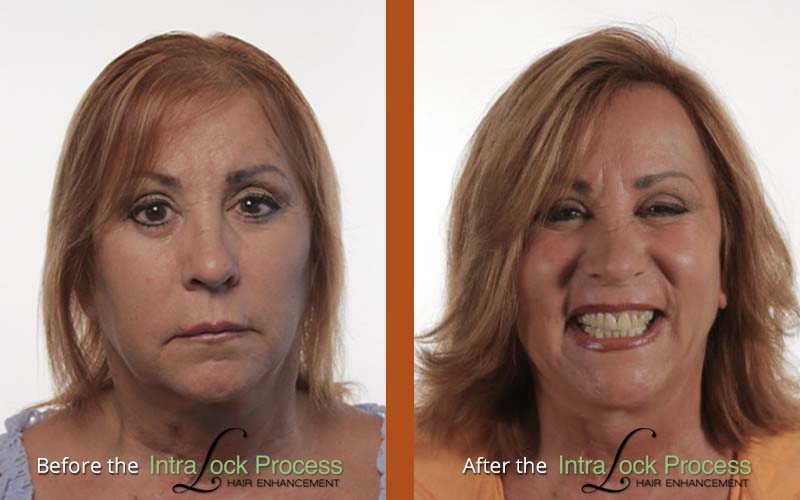
The Hair for Life Center has worked with women across the Tri-State Area for over 30 years, and our approach is one of the options described above. The Intralock Process loops a fine filament around 4 to 8 strands of your existing hair, safely creating length, volume, and density in as little as 3 hours. No glues. No clips. No cylinders. No surgery. Whether it is the right fit for you is exactly what a consultation is for — and if it is not, we will tell you.
Every client relationship begins with a free, private, no-pressure consultation. We assess your hair and scalp, listen to your goals, and give you an honest picture of what is possible for your specific situation. You can also see before and after photos from women who came to us frustrated with their options, or read through our frequently asked questions on maintenance and pricing.